
Electrolysis
Chin hair in women: why does it appear and how can you get rid of it for good?
One hair thicker than the others, spotted in the car mirror. Then two, then five. And the habit of keeping tweezers within reach, just in case. If this sounds familiar, know one thing first: you are far from alone. Chin hair is one of the most common reasons for visiting a salon, at any age.
In this article, we explain why these hairs appear, when it's best to talk to a doctor, and which methods get rid of them for good, especially electrolysis.
Why do hairs grow on the chin?
Vellus and terminal hair: two very different hairs
Our face is entirely covered in vellus hair: very fine, short, light hairs that are almost invisible. The problem starts when some follicles begin producing terminal hairs: longer, thicker, often darker and sometimes a little coarse to the touch.
This change from vellus to terminal hair is mainly driven by androgen hormones, naturally present in women in smaller amounts than in men. The follicles of the chin, upper lip and neck are particularly sensitive to these hormones.
The role of hormones
You don't need high androgen levels to see a few chin hairs appear. In many women, hormones are perfectly normal; the follicles are simply more reactive. Genetics and ethnic background also play an important role.
In other cases, a hormonal imbalance is involved. The best known is polycystic ovary syndrome (PCOS), which may come with irregular cycles, acne or weight gain. Some medications can also encourage hair growth.
Age-related changes
Around menopause, oestrogen production falls while androgen production declines more slowly. This shifting balance explains why many women see chin hairs appear from their forties or fifties. With age, these hairs also often turn grey or white, which matters a lot when choosing a hair removal method.
When should you seek medical advice?
A few isolated hairs are usually harmless. However, it is advisable to see your GP, a gynaecologist or an endocrinologist if:
- the hairs appear quickly or in large numbers;
- they also affect other areas: cheeks, neck, chest, abdomen, back;
- your periods are irregular or absent;
- you notice persistent acne, hair loss on the top of the head or a deepening voice;
- the growth started after taking a new medication.
A check-up can identify a possible hormonal cause and treat it. Hair removal remains entirely possible afterwards, and often complements medical treatment.
Chin hair removal methods: pros and limits
Tweezers
It's many women's reflex. Handy for a single hair, but the result only lasts a few weeks. Over time, repeated plucking can irritate the skin, cause ingrown hairs and small marks. Contrary to popular belief, tweezing doesn't make more hairs grow, but it doesn't solve the problem.
Wax and threading
Faster over a whole area, wax and threading also pull the hair out by the root. Results last a few weeks. On sensitive or mature skin, they can cause redness and irritation, and ingrown hairs are common on the chin.
Shaving and depilatory creams
Shaving doesn't make hairs thicker or darker: that's a myth. But it cuts the hair at the surface, and it grows back prickly within a day or two. Depilatory creams, for their part, can irritate the delicate skin of the face.
Laser
Laser hair removal is an excellent solution for dark hairs, because it targets melanin, the hair's pigment. Its weak point: white, grey, blond or red hairs, which contain too little pigment to be reached. Yet on the chin, these are precisely the hairs that often cause problems from a certain age. We explain how laser works in our guide to laser hair removal in Brussels.
Electrolysis
Electrolysis is the only method that treats hairs one by one, at the root, whatever their colour. That is why it is often the method of choice for the chin.
How does electrolysis work?
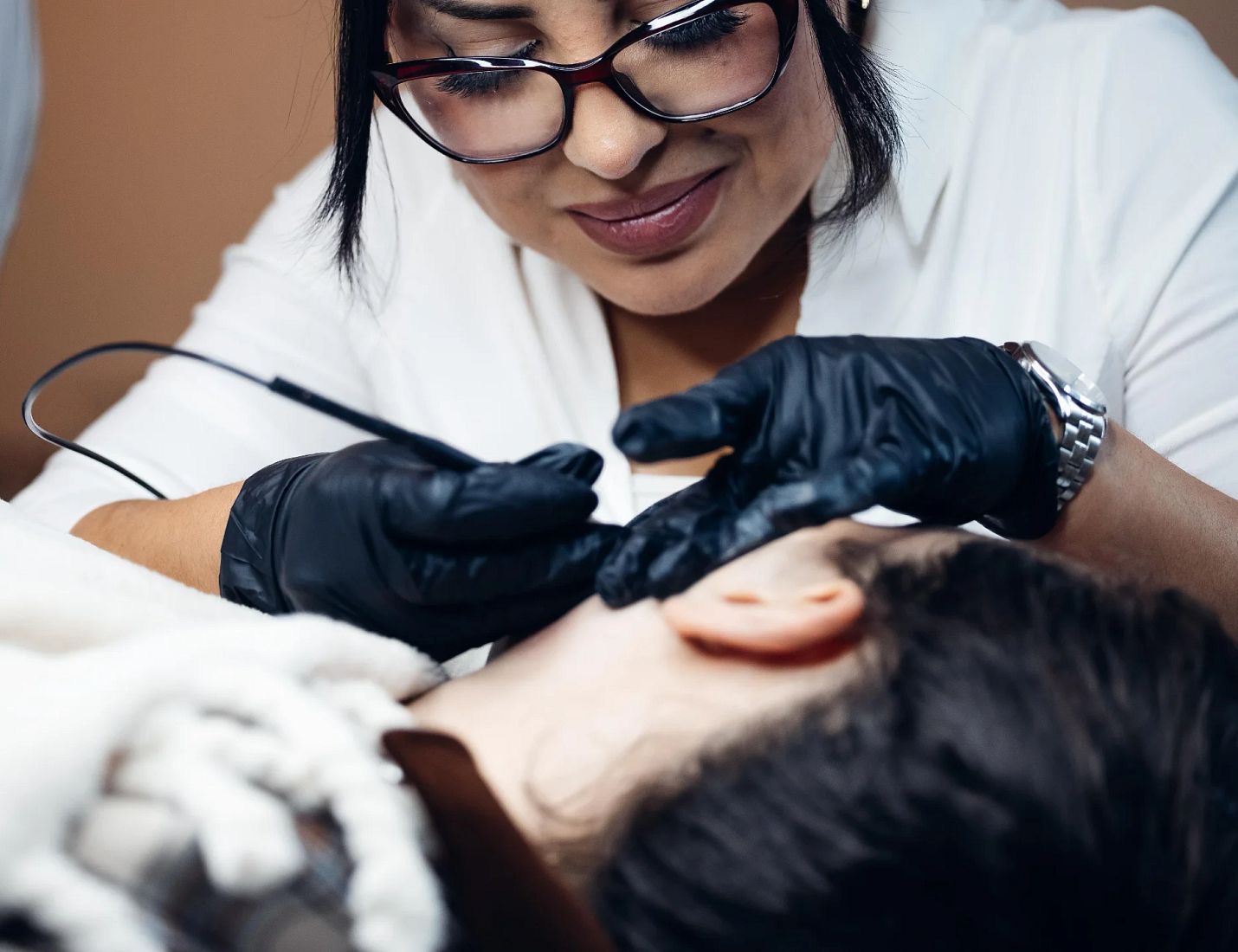
Electrolysis, also called electrical hair removal, involves slipping a very fine probe into the natural opening of the follicle, along the hair, down to the root. A light electric current is then sent to destroy the bulb, the part that produces the hair. The hair is then gently removed with tweezers, without resistance.
There are several techniques:
- Galvanic (electrolysis in the strict sense): a direct current causes a chemical reaction that destroys the follicle.
- Thermolysis: a high-frequency current produces very localised heat.
- A mix of both ("blend"), combining the two actions.
The choice of technique and settings depends on the type of hair, its depth and the sensitivity of the skin.
Electrolysis or laser: which to choose for the chin?
| Electrolysis | Laser | |
|---|---|---|
| Hair colour | All, including white and blond | Dark hair only |
| Principle | Hair by hair, at the root | A whole area with each pass |
| Ideal for | Small areas, light hairs, remaining hairs | Large areas, dark and numerous hairs |
| Result | A correctly treated hair does not grow back | Long-lasting hair reduction |
The two methods actually complement each other: many people start with laser on an area of dark hair, then finish with electrolysis on the few light or stubborn hairs that remain.
How many sessions will you need?
There's no single answer, because the treatment depends on:
- the number of hairs to treat;
- their thickness and depth;
- the methods used before: years of tweezing or waxing can distort the follicle and make it harder to reach;
- the hormonal context, which can make new hairs appear during treatment.
A hair isn't always at the same growth stage, and some follicles need several passes. In practice, we plan short, regular sessions at first, from a few minutes to half an hour for the chin, then further apart as the hairs become sparser. For a chin with many hairs, treatment often spans several months. Patience pays off: every correctly treated hair is one hair less, for good.
What it feels like, and precautions to take
During the session
Most people describe a small prick or a brief feeling of heat with each hair. Sensitivity varies by area, by person and by the time of the cycle. Short, regular sessions are generally well tolerated.
After the session
- Redness and small swollen spots around the treated hairs are normal; they usually disappear within a few hours.
- Tiny scabs may sometimes appear: don't scratch them, they fall off on their own.
- Avoid make-up on the area for 24 hours, as well as sun, saunas and steam rooms.
- Keep the skin clean and avoid touching it with your fingers.
Between sessions
- Stop using tweezers or wax: the hair must be present in the follicle to be treated. If a hair bothers you, cut it with scissors or shave it.
- Let the hairs grow for a few days before the appointment so they are clearly visible.
Possible side effects
Rarer effects can occur, such as temporary pigmentation marks on olive or dark skin, especially with sun exposure, or a small infection if the area isn't kept clean. That is why settings, hygiene and following the advice are essential.
Some situations require prior advice: a pacemaker or other implanted electronic device, pregnancy, infection or skin lesion on the area, healing disorders. Mention it at your first appointment.
Electrolysis at Victory Beauty, in Wemmel and Jette
At Victory Beauty, we offer electrolysis and thermolysis in our Wemmel and Jette salons, on the edge of Brussels. Sessions are performed by qualified, certified beauty therapists.
- Every hair can be treated: black, brown, blond, red, grey or white.
- Every facial area: chin, upper lip, eyebrows, neck. For men, the beard line, cheeks and nape. And every area of the body.
- Hairs remaining after laser treatment can also be treated.
- Sessions by time: you book a length suited to your area and hair density, from 5 minutes (€15) to 1 hour (€110). For a chin, a 10-minute session costs €25 and a 15-minute session €35.
At the first appointment, we review with you the areas to treat and the most suitable session length.
In short
Chin hair is very common in women and usually linked to a normal sensitivity of the follicles to hormones, or to menopausal changes. If it appears quickly or comes with other signs, medical advice is needed. To get rid of it for good, electrolysis is the most complete method, because it works on every hair, including white ones, provided you are patient and regular.
Frequently asked questions
Is it normal for a woman to have chin hair?
Yes, it's very common. Most of the time, it is a normal sensitivity of certain follicles to hormones, increasing with age and at menopause. Rapid or heavy growth does, however, call for medical advice.
Is electrolysis really permanent?
A hair whose bulb has been correctly destroyed does not grow back. Some hairs need several passes, and new hairs can appear with hormonal changes: a few maintenance sessions are therefore sometimes useful.
Is electrolysis painful?
You feel a small prick or brief heat with each hair. Most people tolerate it very well, especially as chin sessions are short.
Can white chin hairs be treated?
Yes. Electrolysis works on every hair, whatever its colour, unlike laser, which only targets dark hairs.
How long does a chin session last?
Depending on the number of hairs, about 5 to 15 minutes at first, sometimes more. Your therapist will advise you on the right length at the first appointment.
Should you stop tweezing before treatment?
Yes. The hair must be present in the follicle to be treated. Between sessions, cut or shave bothersome hairs rather than pulling them out.
Does electrolysis leave marks?
Redness and small temporary swellings are normal. With suitable settings, good hygiene and following the advice, especially regarding the sun, the risk of marks is low.